

Most people assume that if a supplement contains collagen, it works. The reality is more specific than that. Absorption depends on molecular weight, peptide size, and the source of the collagen itself. Recent research confirms that hydrolyzed peptides in the 2-6 kDa range enter your bloodstream and reach skin tissue in ways that larger protein fragments simply cannot. This article breaks down the science, reviews the best clinical evidence, and gives you practical guidance on how to get real results from collagen supplementation.
Table of Contents
- How collagen peptides work in your body
- Clinical evidence for skin benefits
- Collagen peptides for joint and muscle recovery
- Dosage, safety, and expert nuances
- What most guides miss about collagen peptide benefits
- Explore clean collagen peptide options for your skin and recovery
- Frequently asked questions
Key Takeaways
| Point | Details |
|---|---|
| Absorption depends on peptide source | Low molecular weight and fish peptides are best absorbed for skin and joint benefits. |
| Proven skin improvements | Clinical studies confirm improvements in elasticity, hydration, and wrinkle reduction after 4-12 weeks. |
| Joint pain relief | Collagen peptides offer significant relief and improved function for those with osteoarthritis. |
| Safe supplementation guidelines | Optimal benefits occur at 2.5-10g daily with no adverse effects reported. |
| Industry bias awareness | Always select supplements with transparent sourcing and rely on independent research for results. |
How collagen peptides work in your body
Collagen is the most abundant structural protein in the body, but eating collagen in its raw, unprocessed form does very little. Your digestive system breaks large proteins into amino acids, which your body then uses wherever it needs them, not necessarily in your skin or joints. Hydrolyzed collagen peptides change this equation entirely.
When collagen is hydrolyzed, large triple-helix proteins are broken into short chains called peptides. Low molecular weight peptides in the 2-6 kDa range are absorbed intact as di-peptides and tri-peptides, particularly the sequence Gly-Pro-Hyp (glycine, proline, hydroxyproline). These small chains pass through the intestinal wall, enter your bloodstream, and travel to connective tissue, where they stimulate fibroblasts. Fibroblasts are the cells responsible for producing new collagen and elastin. Once activated, they also reduce the activity of matrix metalloproteinases (MMPs), enzymes that break down collagen in the skin. The net result is a measurable increase in collagen synthesis and a slowdown of degradation.
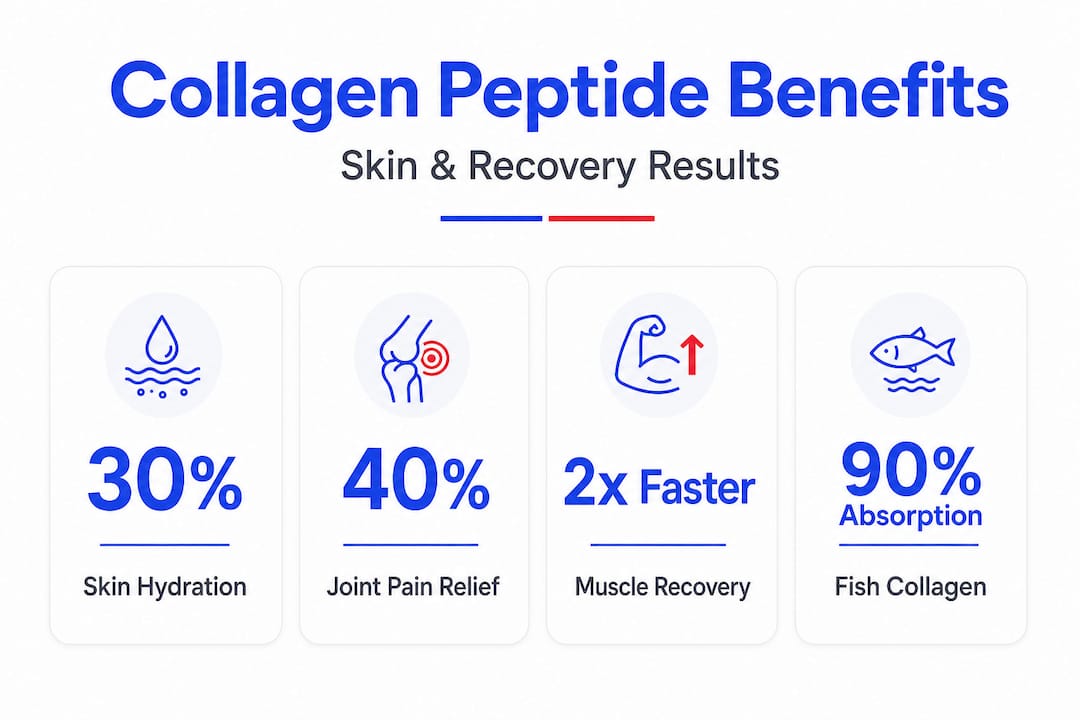
Source matters just as much as molecular weight. Collagen source impact studies show that fish (marine) collagen from fish scales provides superior absorption compared to porcine or bovine sources. The reason is structural: fish collagen has a naturally lower molecular weight, making it easier for your gut to absorb the intact peptide sequences that drive biological activity. Collagen sources and efficacy vary widely across the supplement market, and many products fail to specify the source or processing method.
| Collagen source | Molecular weight range | Relative absorption |
|---|---|---|
| Fish (marine) | 1-3 kDa | Highest |
| Bovine (grass-fed) | 2-5 kDa | High |
| Porcine | 3-8 kDa | Moderate |
| Gelatin (unhydrolyzed) | 100+ kDa | Low |
Key factors that determine how well a collagen peptide supplement will work:
- Molecular weight: Look for products specifying under 5 kDa
- Hydrolysis method: Enzymatic hydrolysis preserves bioactive sequences better than acid hydrolysis
- Source animal: Grass-fed bovine or wild-caught marine sources are preferable
- No fillers: Added maltodextrin, artificial sweeteners, or binding agents can affect absorption rates
Pro Tip: Check the supplement label for the phrase “hydrolyzed collagen peptides” and verify that the molecular weight is listed. If neither is specified, the product may contain larger protein fragments with limited bioavailability.
With an understanding of how collagen peptides enter your system, let’s explore the visible benefits they offer for skin.
Clinical evidence for skin benefits
The clinical research on collagen peptides and skin health is substantial, though not without nuance. Multiple RCTs confirm that taking 2.5 to 5 grams of collagen peptides daily for 4 to 12 weeks produces statistically significant improvements in skin elasticity (measured at R2, R5, and R7 levels), surface and deep hydration, dermal density and thickness, wrinkle depth and volume, and pore size in healthy women aged 35 to 65.
What makes these findings especially useful is the sustained effect. Post-discontinuation studies show that skin improvements persist for 2 to 4 weeks after stopping supplementation. This means collagen peptides trigger a structural change in the skin rather than just a temporary cosmetic effect. Researchers attribute this durability to the high hydroxyproline content in bioactive peptides and the low molecular weight that enables deep tissue distribution.
Key collagen trial results from well-designed studies follow this pattern:
- Improvements in skin elasticity appear as early as 4 weeks at 2.5g/day doses
- Hydration benefits tend to peak around weeks 8 to 12 of consistent supplementation
- Wrinkle reduction is most pronounced in participants over 40, where natural collagen loss is accelerating
- Dermal density improvements are visible via ultrasound imaging, confirming structural changes, not just surface appearance
- Benefits accumulate over time, meaning longer supplementation periods generally yield stronger outcomes
However, not all studies tell the same story. Meta-analysis data shows an overall positive result for skin hydration (standardized mean difference of 1.25) and elasticity (SMD of 0.61), but the same analysis found that high-quality, non-industry-funded studies showed noticeably weaker effects. This is worth knowing. It does not mean collagen peptides do not work. It means the magnitude of benefits in some studies is inflated by industry investment.
The honest takeaway: collagen peptides provide real, measurable skin benefits, but anyone promising dramatic results in days or weeks is overselling the science.
Complementing your supplementation with topical support from skin firming and collagen products may also amplify outcomes by working from the outside while peptides work from within.
Collagen peptides for joint and muscle recovery
Collagen is not just a skin supplement. Some of the most compelling clinical evidence involves joint health, particularly in people with osteoarthritis (OA) or high-volume athletic training.

Joint pain reduction data shows that collagen peptides at doses ranging from 5 to 40 mg per day reduce joint pain by approximately 40% based on WOMAC scores in people with knee OA grades I and II. The mechanism runs through two channels: anti-inflammatory peptide sequences that reduce local cytokine activity, and signaling peptides that stimulate cartilage matrix repair. This is not passive lubrication, it is active structural support.
For active individuals, the picture is more mixed. Integrative review data on recovery supports reduced muscle soreness following resistance training with collagen peptide supplementation. But some RCTs show no meaningful advantage over free amino acid blends or placebo for post-exercise protein synthesis rates. This tells us that collagen peptides are not a replacement for complete protein sources like whey or eggs when the goal is muscle building. Their real strength lies in connective tissue repair, joint cushioning, and reducing the cumulative wear that comes with consistent training.
“The most underused application for collagen peptides in athletic populations is for tendon and ligament resilience. Cartilage and connective tissue turnover is slower than muscle, but collagen supplementation specifically supports the matrix structures that are most vulnerable to repetitive stress.”
You can explore well-sourced options across the full supplement recommendations range to complement a resistance training or recovery protocol. The research on joint health research confirms that Type I collagen hydrolysate, the form found in bovine and marine sources, produces the strongest outcomes for bone and joint tissue when used consistently.
Pro Tip: For recovery-focused use, take collagen peptides 30 to 60 minutes before exercise or immediately after. Some research suggests that pairing collagen with vitamin C at the same time accelerates collagen synthesis in connective tissue.
Dosage, safety, and expert nuances
The good news on safety is clear and consistent. Clinical safety reviews confirm that collagen peptides are safe across all major human trials, with no adverse events reported at doses between 2.5 and 10 grams per day. This is the practical daily window for most adults, with skin benefits clustering around 2.5 to 5g and joint or recovery benefits appearing more strongly at 5 to 10g.
Practical dosage guidelines based on your primary goal:
- Skin elasticity and hydration: 2.5 to 5g per day for a minimum of 8 weeks
- Joint pain and OA support: 5 to 10g per day, ideally taken consistently for 12 or more weeks
- Active recovery support: 5 to 10g per day, timed around training sessions
- General maintenance: 2.5g per day is a reasonable baseline for adults over 35
One nuance that most supplement guides skip: the quality of the base product matters as much as the dose. Avoiding synthetic fillers is critical because common additives like maltodextrin, silicon dioxide, and artificial flavors can compete with peptide absorption or introduce compounds that counteract the clean nutrition goal entirely.
Pro Tip: Choose a collagen peptide product that lists grass-fed or pasture-raised sourcing, specifies the molecular weight or states “hydrolyzed,” and carries GMP certification from a US-based facility. These three markers cut through most of the noise in the supplement market.
The expert nuance worth repeating: many of the most-cited collagen studies are industry-funded, and supplement safety profile data should be read alongside independent systematic reviews to get an accurate picture of effect sizes.
What most guides miss about collagen peptide benefits
Most articles on collagen peptides focus on whether the ingredient works in general. Very few get into why two products with the same label claim can produce completely different results. The answer comes back to peptide architecture, not marketing copy.
A 10g serving of collagen from a poorly sourced, unspecified molecular weight product may deliver far less bioavailable Gly-Pro-Hyp than a 5g serving of precisely hydrolyzed, low molecular weight peptides from a clean source. The number on the label is almost irrelevant if the underlying processing and sourcing are opaque.
We also see an over-reliance on industry-funded trial data across the supplement industry. The positive effect sizes in sponsored studies are consistently larger than those in independent research. This does not mean collagen peptides are a scam. It means you need to look past flashy before-and-after claims and find brands that cite independent data and are transparent about where their collagen comes from, how it is processed, and what the actual peptide profile looks like.
The advanced collagen advice we consistently offer points to one core principle: source integrity and processing quality are the two factors that separate supplements that deliver from those that just look good on a shelf. Grass-fed sourcing matters because the amino acid profile of connective tissue from healthy, pasture-raised animals is richer in the specific sequences (hydroxyproline, proline, glycine) that drive real outcomes.
The uncomfortable truth is that price and brand recognition tell you almost nothing about collagen quality. Transparency in sourcing, molecular weight specification, and independent certification tell you everything.
Explore clean collagen peptide options for your skin and recovery
If the clinical evidence has convinced you that peptide quality and sourcing are where results are won or lost, the next step is finding products that actually meet that standard.

At Cohld, our grass-fed collagen peptides are sourced exclusively from pasture-raised animals, hydrolyzed for optimal bioavailability, and free from synthetic fillers, artificial additives, and hormone disruptors. Every batch is produced in a US-based, GMP-compliant facility. For a complete skin support approach, pair collagen supplementation with our skin firming cream, formulated to work alongside your internal collagen protocol. Browse the full supplement collection to find the right combination for your skin and recovery goals.
Frequently asked questions
How long does it take to see results from collagen peptides?
Clinical trials confirm that noticeable improvements in skin elasticity, hydration, and wrinkle depth typically appear within 4 to 12 weeks of consistent daily supplementation at 2.5 to 5 grams per day.
Are collagen peptides safe and free from adverse effects?
Yes. Safety review data confirms no adverse events across human trials at doses of 2.5 to 10 grams per day, making collagen peptides one of the most consistently well-tolerated supplements available.
Do collagen peptides help joint pain and osteoarthritis?
Yes. Clinical evidence shows approximately 40% reduction in joint pain based on WOMAC scores in knee OA patients, alongside improved function through anti-inflammatory and cartilage matrix signaling mechanisms.
Which collagen source is best for absorption?
Fish (marine) collagen has the highest absorption rate due to its naturally low molecular weight. Source comparisons consistently show fish scales outperform porcine and are competitive with high-quality bovine sources when both are properly hydrolyzed.
Are the skin benefits permanent after stopping collagen peptides?
Not permanently, but improvements in skin elasticity and hydration persist for 2 to 4 weeks after discontinuation, indicating structural changes rather than surface-only effects.