

You pick up a supplement bottle labeled “natural” and feel good about your choice. But flip it over, and you’ll find a long list of ingredients you can’t pronounce. Magnesium stearate, titanium dioxide, PEG compounds, and “fragrance” can hide inside products that market themselves as pure and clean. These synthetic fillers often serve the manufacturer’s needs, not yours. They improve texture, extend shelf life, and cut costs. This guide walks you through exactly what to look for, how to decode ingredient labels, and how to find products that genuinely deliver on their clean promises.
Table of Contents
- Why avoid synthetic fillers?
- Common synthetic fillers to avoid
- How to read labels and spot synthetic fillers
- Choosing and using truly clean products
- Why going filler-free is harder (and more rewarding) than most advice admits
- Find your next clean supplement or skincare solution
- Frequently asked questions
Key Takeaways
| Point | Details |
|---|---|
| Check certifications | Look for labels like USDA Organic, NSF, or EWG Verified to avoid synthetic fillers. |
| Learn ingredient names | Know the most common synthetic fillers so you can spot them instantly on product labels. |
| Use ingredient-scanning apps | Boost your label-reading power using tools like EWG Skin Deep or Clearya. |
| Expect cleaner results | Filler-free products often deliver more noticeable benefits and fewer sensitivities. |
Why avoid synthetic fillers?
Synthetic fillers are inactive ingredients added to products to bulk them up, improve flow during manufacturing, or extend shelf life. They don’t contribute to the product’s core benefit. In supplements, they bind tablets, fill capsule space, and prevent clumping. In skincare, they create silky textures, extend product life, and add artificial color or scent.
The problem is that many of these additives come with real trade-offs. Research confirms that synthetics may dilute potency, cause sensitivities, or disrupt skin barrier and gut health over time. Pure natural ingredients, by contrast, tend to support absorption, reduce inflammation, and align with wellness goals that health-conscious consumers actually care about.
Here’s a quick breakdown of why fillers matter:
- Reduced bioavailability: When a capsule is packed with flow agents and binders, there’s simply less room for the active ingredient. You may be paying full price for a fraction of the benefit.
- Sensitivities and reactions: Fillers like carrageenan, artificial dyes, and certain preservatives are common triggers for gut irritation and skin flares, especially with daily use.
- Endocrine disruption: Some synthetic ingredients, like certain parabens and phthalates found in “fragrance,” are known hormone disruptors that accumulate in tissue over time.
- Barrier damage: In skincare, silicones and ethoxylated compounds (like PEG derivatives) can suffocate pores and weaken the skin’s natural barrier when used long term.
It’s worth noting one exception to the avoid-everything-synthetic rule. Some lab-made ingredients genuinely earn their place. Hyaluronic acid synthesized in a lab, for example, delivers targeted hydration benefits and is well-tolerated by most people. The point isn’t to reject all non-natural chemistry. The point is to reject ingredients that serve the manufacturer at your expense.
When you’re comparing supplements side by side, ingredient lists tell the real story. A product with five clean, recognizable ingredients often outperforms a product with twenty-five additives. For context, look at supplement examples that prioritize minimal, functional ingredient lists to see what clean sourcing actually looks like on a label.
“Natural ingredients support absorption, reduce inflammation, and align with organic and wellness goals, while synthetic fillers can dilute potency and disrupt long-term health.” — Non-GMO Project
Common synthetic fillers to avoid
Once you understand why fillers are a problem, the next step is knowing their names. Manufacturers often use chemical nomenclature that makes harmful additives sound harmless. Here are the biggest offenders broken into two categories.
In supplements:
- Magnesium stearate is a lubricant that keeps ingredients from sticking to manufacturing equipment. It’s one of the most common supplement fillers and is found in the majority of tablet and capsule products.
- Titanium dioxide is used to make pills white and visually uniform. It serves no nutritional purpose whatsoever.
- Microcrystalline cellulose (MCC) acts as a filler and binder in tablets. While derived from cellulose, heavily processed MCC contributes zero nutritional value.
- Silicon dioxide prevents caking and is used in powder products. Technically inert, but it’s a signal that manufacturing shortcuts are being taken.
- Artificial colors like FD&C Blue No. 1 and Red No. 40 are used to make products look appealing. They have no health benefit and are linked to behavioral issues and sensitivities in some individuals.
- Carrageenan is a thickener derived from seaweed that sounds natural but is associated with gut inflammation in several studies.
In skincare:
For minimal synthetic skincare, understanding ethoxylated ingredients is essential. Research from Consumer Reports shows you should avoid ethoxylated ingredients ending in “-eth” (like laureth and polysorbate), parabens, phenoxyethanol, silicones (dimethicone, cyclopentasiloxane), quaternary ammonium compounds, artificial dyes, and undisclosed fragrance.
| Filler | Product type | Primary concern |
|---|---|---|
| Magnesium stearate | Supplements | Reduces absorption |
| Titanium dioxide | Supplements, makeup | No nutritional value, potential toxicity |
| PEG compounds | Skincare | Ethoxylation byproducts, penetration enhancement |
| Parabens | Skincare | Endocrine disruption |
| Dimethicone | Skincare | Occlusive barrier, pore suffocation |
| Artificial fragrance | Skincare, supplements | Undisclosed allergens, hormone disruptors |
| Carrageenan | Supplements, food | Gut inflammation |
| FD&C dyes | Both | Sensitivities, no benefit |
How to spot synthetic fillers on a label:
- Look for ingredients ending in “-eth,” “-xynol,” or “-siloxane” in skincare.
- Watch for color codes like “FD&C” followed by a color and number.
- Any ingredient listed as “fragrance” or “parfum” is a single entry that can legally contain hundreds of undisclosed chemicals.
- In supplements, the longer the “Other Ingredients” section, the more fillers are likely present.
Pro Tip: Products that are truly fragrance-free will say so explicitly. “Unscented” is not the same thing. Unscented products often contain masking fragrance to neutralize other odors, which means chemicals are still present.
How to read labels and spot synthetic fillers
Knowing which ingredients to avoid is half the battle. The other half is knowing how to verify that the products you buy actually do what they claim. This is where certifications and digital tools become your best allies.
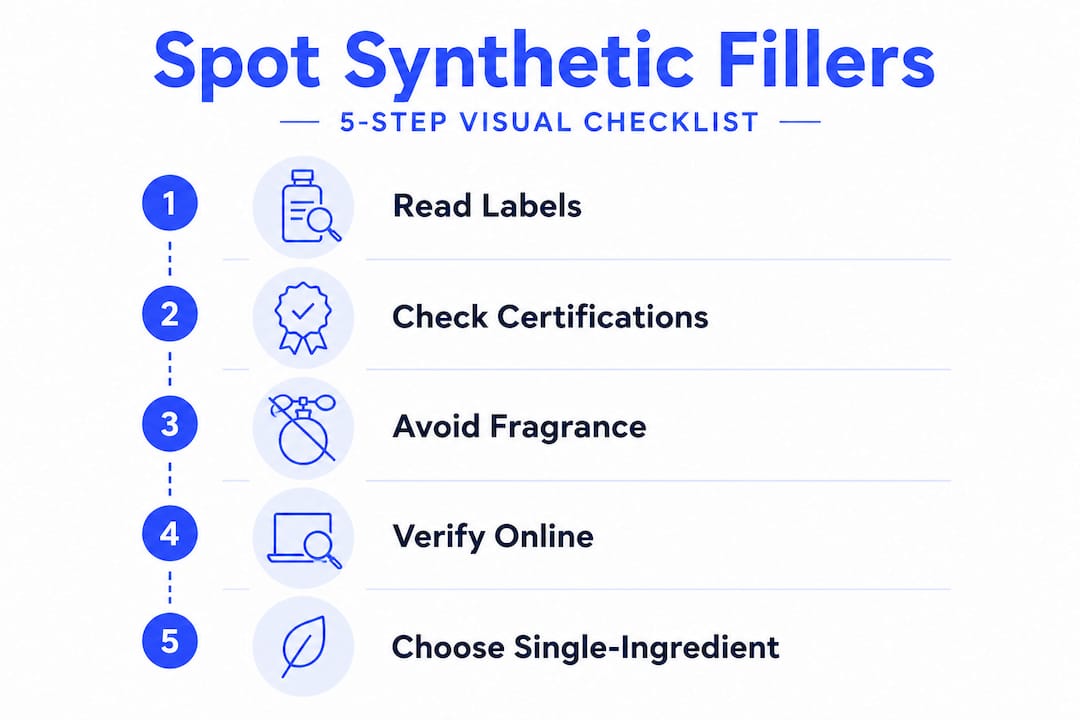
Step-by-step label reading:
- Start with the “Other Ingredients” section on supplement labels. This is where fillers live. The shorter this section, the better.
- Read skincare ingredients in order. Cosmetic ingredient lists are listed in descending order of concentration. If a beneficial ingredient appears near the bottom after a long list of synthetic fillers, there’s very little of it in the formula.
- Decode PEG numbers. PEG-4, PEG-40, PEG-100 all indicate ethoxylation, a chemical process that can introduce harmful byproducts. The number indicates molecular weight, not safety.
- Flag “fragrance” immediately. It’s a legally protected term that can mask hundreds of undisclosed chemicals, many of which are allergens or hormone disruptors.
- Look for certification seals. These are the most reliable shortcut for identifying clean products.
Research confirms that third-party certifications like NSF, USP, EWG Verified, Made Safe, USDA Organic, and Non-GMO Project Verified are among the most trustworthy indicators that a product avoids harmful synthetics. These seals require independent verification and mean that the product has been tested, not just labeled.
| Certification | What it verifies |
|---|---|
| NSF Certified | Ingredient purity, label accuracy, contaminant limits |
| USP Verified | Potency, dissolving standards, good manufacturing practices |
| EWG Verified | Free from EWG-flagged chemicals, full transparency |
| Made Safe | Free from known harmful chemicals, ecosystem safety |
| USDA Organic | At least 95% organic ingredients, no synthetic additives |
| Non-GMO Project Verified | No genetically modified organisms |
Our grass-fed collagen peptides are a great real-world example of what this looks like in practice. Single-ingredient, sourced from grass-fed cattle, and manufactured in a GMP-compliant facility with zero synthetic fillers in the formula.
Beyond reading labels, digital tools fill the gaps that marketing language creates. Apps like EWG Skin Deep, Clearya, Yuka, and Detox Me allow you to scan a product’s barcode and instantly see ingredient scores, flagged chemicals, and safer alternatives. EWG Skin Deep has a database of over 120,000 personal care products. Clearya works directly in your browser while you shop online, surfacing concerns in real time.
Pro Tip: Marketing terms like “natural,” “clean,” “green,” and even “non-toxic” carry no regulatory definition in the US. A certification seal from a reputable third party is the only claim that has been independently verified. Trust the seal, not the front label language.
Always verify your product choices at cohld.com to see brands that lead with full ingredient transparency rather than persuasive packaging.
Choosing and using truly clean products
Now that you can read labels and verify certifications, you’re ready to make smart purchasing decisions and build a filler-free routine that actually sticks.
How to transition without overwhelm:
- Start with your highest-use products. Daily supplements and face moisturizers get the most contact time with your body. Swap these first.
- Do a spot test with new skincare. Even natural formulations can cause reactions in some people. Apply a small amount to the inside of your wrist and wait 24 hours before using it on your face or body.
- Introduce new supplements gradually. Titration means starting with a smaller dose and building up. This gives your body time to adjust and helps you identify if something doesn’t agree with you.
- Expect sensory differences. Clean products often look, smell, and feel different from heavily processed options. Grass-fed tallow cream, for example, is thicker and has a faint natural scent rather than the artificial fragrance of conventional moisturizers. This is normal and not a sign of lower quality.
- Check batch certifications, not just the front label. Reputable manufacturers make Certificates of Analysis (COAs) available for each production batch. These documents verify that what’s on the label matches what’s in the product.
Importantly, the industry itself is catching up. Empirical data shows that clean formulations improve manufacturing reliability without synthetics via plant-based options, enabling USDA Organic certification that was previously impossible with conventional fillers. Brands like RIBUS have developed natural alternatives to microcrystalline cellulose that actually perform as well or better in manufacturing. This is good news. Clean formulation is no longer a compromise. It’s becoming the standard for quality-focused brands.
What to realistically expect from clean products:
- Shorter ingredient lists that are easier to research and verify
- Potentially higher price points, though bulk buying and subscriptions often offset the difference
- Shorter shelf life in some cases, because preservatives are limited to natural options
- Faster, more noticeable results in some areas, particularly for skin health and digestive comfort, as the body isn’t working around unnecessary additives
When choosing no-filler supplements, look for products that list every ingredient clearly, including sourcing information, and that provide access to third-party testing results on request.
Pro Tip: Always check batch certifications, not just the front label. A COA issued for a specific batch number is the gold standard in supplement transparency. If a brand won’t share it, that tells you something important.
“USDA Organic certification in supplement manufacturing, once considered impossible with conventional fillers, is now achievable through plant-based alternatives that match synthetic performance.” — GlobeNewswire, 2026
Why going filler-free is harder (and more rewarding) than most advice admits
Here’s the honest part that most clean-living guides skip over. Going genuinely filler-free is not a weekend project. It takes patience, some budget adjustment, and the ability to sit with trade-offs that don’t have perfect answers.
Most popular “natural” products still rely on synthetics for shelf life, sensory appeal, or manufacturing ease. A lotion that feels luxurious and spreads smoothly is usually that way because of dimethicone, a silicone that coats the skin. A supplement that stays fresh on a retailer’s shelf for three years probably contains preservatives and flow agents you wouldn’t choose knowingly. The aesthetic and logistical benefits of synthetics are real, which is exactly why they’re so pervasive even in products that market themselves as clean.
What works better than all-or-nothing thinking is consistency over perfection. If you swap your daily collagen powder and face moisturizer to clean options, you’ve meaningfully reduced your synthetic exposure even if your sunscreen still contains a synthetic preservative. An isolated exposure here and there isn’t the issue. Chronic, daily contact with the same synthetic disruptors is.
Smaller brands tend to offer genuinely better formulations because their business model depends on transparency and trust rather than mass-market shelf appeal. That said, they require more research on your part. Checking for COAs, reading third-party reviews, and understanding sourcing takes time. The payoff is real: noticeably clearer skin, fewer reactions, and a digestive system that isn’t managing constant low-level irritation from unnecessary additives.
If you want a straightforward starting point for affordable truly natural skincare, grass-fed tallow cream represents what clean formulation actually looks like. The ingredient list is short. The sourcing is traceable. The skin benefits from fat-soluble vitamins that synthetic alternatives simply can’t replicate. The transition takes a few weeks for your skin to adjust, but the results speak for themselves.
The most important thing we’ve learned working in this space is that the bar for the word “natural” is embarrassingly low in the US market. Regulatory gaps mean brands can use that word without any meaningful verification. Your protection comes from certifications, from COAs, and from brands willing to show their work. That standard protects you whether or not regulations catch up.
Find your next clean supplement or skincare solution
You now have a clear framework for identifying synthetic fillers, reading labels, verifying certifications, and making the transition to genuinely clean products. The next step is applying that knowledge with products you can actually trust.

At Cohld, every product on our shelves is formulated without synthetic fillers, artificial additives, or hormone disruptors. Our pure collagen peptides are sourced from grass-fed, pasture-raised cattle and contain a single active ingredient with no manufacturing shortcuts. Our tallow cream for skin is made from grass-fed tallow with a short, transparent ingredient list that feeds your skin the fat-soluble nutrients it actually recognizes. Browse our full range of all clean products to find options that match the standards you’ve just learned to look for. Every product comes with complete ingredient transparency and is sourced from GMP-compliant, US-based facilities.
Frequently asked questions
What are the most common synthetic fillers in supplements?
Common synthetic fillers include magnesium stearate, titanium dioxide, silicon dioxide, and artificial dyes like FD&C colors, which appear frequently in tablets and capsules.
How do I know if a product is truly “filler-free”?
Look for reputable third-party certifications like NSF, USP, EWG Verified, or USDA Organic, and cross-check the ingredient list using a trusted app like EWG Skin Deep or Clearya.
Are there safe synthetic ingredients I don’t need to avoid?
Yes. Some lab-made ingredients, including hyaluronic acid targeted benefits, are well-tolerated and serve a genuine functional purpose in properly formulated products.
What digital tools help spot hidden synthetic fillers?
EWG Skin Deep, Clearya, Yuka, and Detox Me are the most reliable options for scanning product barcodes or ingredient lists to identify harmful synthetics and find verified clean alternatives.
Will switching to filler-free products change results?
Many people notice fewer sensitivities, improved skin clarity, and better supplement absorption, though some products may feel or look different because synthetics may dilute potency and affect texture in conventional formulations.