

Not all collagen supplements are created equal, and the sourcing story behind your daily scoop matters more than most labels let on. Consumers shopping for recovery support or skin health often treat collagen as a commodity, grabbing the cheapest tub without questioning whether the animals it came from were grain-fed, hormone-treated, or raised in confinement. Grass-fed collagen represents a meaningfully different category, one defined by stricter sourcing standards, cleaner ingredient profiles, and a production philosophy rooted in the quality of the raw material. This article breaks down exactly what that means for your body and how to make smarter choices.
Table of Contents
- What is grass-fed collagen?
- Key differences: Grass-fed versus conventional collagen
- Grass-fed collagen for skin, recovery, and wellness
- How to choose and use grass-fed collagen supplements
- Our perspective: The real story behind grass-fed collagen
- Explore grass-fed collagen and clean supplements
- Frequently asked questions
Key Takeaways
| Point | Details |
|---|---|
| Grass-fed collagen definition | Grass-fed collagen is sourced from cows fed primarily grass, resulting in a purer supplement with minimal additives. |
| Key differences | Grass-fed collagen may offer better purity and transparency compared to conventional collagen, but not always superior results for joint health. |
| Skin and wellness benefits | Grass-fed collagen can support skin hydration and recovery, although consistent use is essential for visible effects. |
| Choosing quality | Carefully review labels and sourcing information to ensure you select genuinely grass-fed products with no unwanted fillers. |
| Editorial perspective | Sourcing and ingredient quality matter more than marketing hype when choosing collagen supplements. |
What is grass-fed collagen?
Grass-fed collagen is a protein supplement derived from the hides, bones, and connective tissues of cattle that spent their lives grazing on open pastures and eating only grass. That distinction sounds simple, but it has significant downstream effects on the quality of the final product.
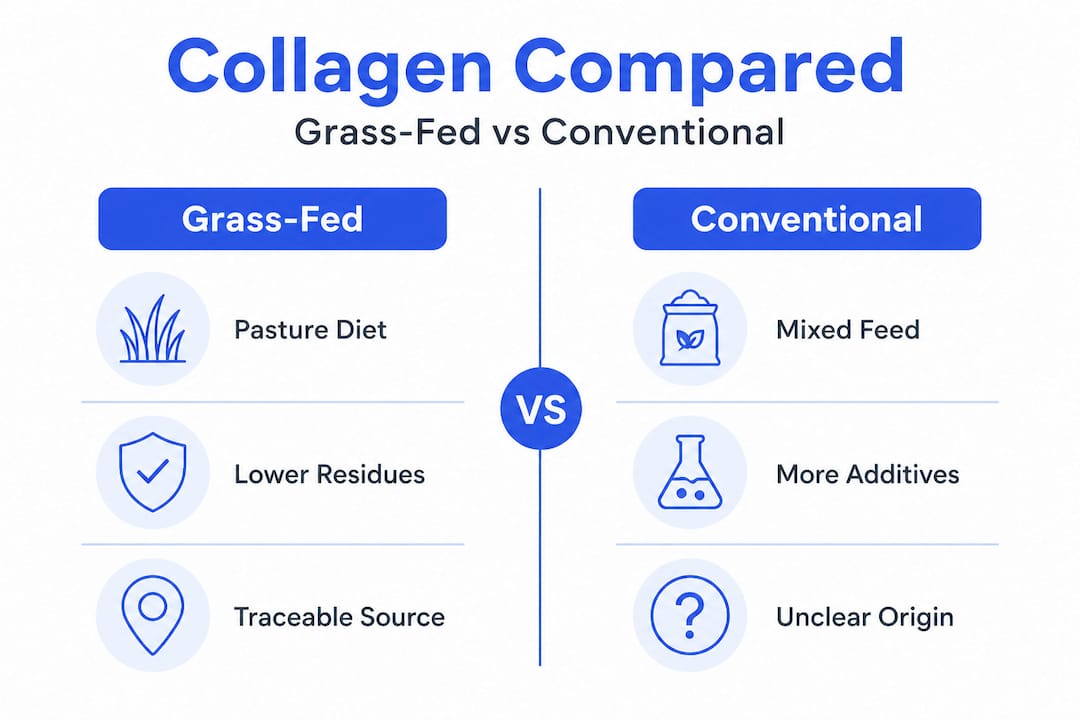
Conventional collagen, by contrast, often comes from cattle raised in concentrated animal feeding operations (CAFOs), where grain-based diets, antibiotics, and growth hormones are standard. Some conventional products also blend bovine collagen with marine or porcine sources without clear labeling, making it harder for consumers to know exactly what they are getting. Grass-fed bovine collagen typically comes from a single, traceable source, which simplifies the production chain and reduces contamination risk.
The production process for high-quality grass-fed collagen follows a few consistent steps:
- Sourcing: Hides and bones are collected from certified grass-fed, pasture-raised cattle
- Hydrolysis: The raw collagen is broken down into smaller peptides (called hydrolyzed collagen or collagen peptides) through an enzymatic process that improves absorption
- Filtration and drying: The resulting liquid is filtered and spray-dried into a fine, flavorless powder
- Testing: Reputable manufacturers test for heavy metals, microbial contamination, and hormone residues before packaging
These steps matter because shortcuts at any stage, such as incomplete hydrolysis or skipping third-party testing, can reduce bioavailability and introduce unwanted substances.
| Feature | Grass-fed collagen | Conventional collagen |
|---|---|---|
| Animal diet | Grass and pasture only | Grain, corn, soy |
| Hormone use | None or minimal | Often present |
| Source traceability | High | Variable |
| Additive risk | Low | Higher |
| Collagen types | Primarily Type I and III | Type I, II, III (variable) |
Worth noting: even well-formulated collagen products face scrutiny in clinical research. One UC-II and hydrolyzed collagen trial found no significant difference versus placebo for knee osteoarthritis symptoms over 12 weeks. That does not mean collagen is useless, but it does mean sourcing transparency and purity matter more than marketing claims alone.
If you are new to supplementing with collagen, grass-fed collagen peptides sourced from pasture-raised cattle offer a clean starting point. For a broader orientation on what to look for, the collagen supplement guide walks through the full selection process from beginning to end.
Key differences: Grass-fed versus conventional collagen
With a clear definition in mind, let’s examine how grass-fed collagen stands out from conventional alternatives in ways that actually affect your health outcomes.
The most important difference is what goes into the animal before the collagen is ever extracted. Grain-fed cattle accumulate a different fatty acid profile than grass-fed cattle, and while collagen itself is a protein with minimal fat content, the overall inflammatory load from a grain-fed supply chain can carry over into the product through residues and processing byproducts. Grass-fed animals also tend to have lower antibiotic exposure, which matters for people prioritizing gut health and microbiome integrity.
Here is a direct comparison across the most relevant factors:
| Factor | Grass-fed | Conventional |
|---|---|---|
| Omega-3 to omega-6 ratio | More balanced | Higher in omega-6 |
| Antibiotic residue risk | Low | Moderate to high |
| Hormone residue risk | Very low | Present in many sources |
| Heavy metal testing | Typically more rigorous | Variable |
| Price point | Higher | Lower |
| Certification availability | Common (USDA, Certified Grass-Fed) | Rare |
Practically, grass-fed collagen supports three main health areas that matter to most wellness-focused consumers:
- Skin integrity: Type I and Type III collagen, the dominant types in bovine sources, are the structural proteins most responsible for skin firmness and elasticity
- Joint and connective tissue support: Glycine, proline, and hydroxyproline, the amino acids that make up collagen, are the raw materials for cartilage, tendons, and ligaments
- Digestive lining repair: Glycine specifically plays a role in maintaining the gut mucosal lining, which affects nutrient absorption and overall digestive comfort
That said, research on collagen supplements remains mixed. The same clinical trial noted above shows that not every formulation outperforms placebo in joint-specific applications. This reinforces the importance of choosing a product based on quality rather than exaggerated promises.
Pro Tip: When reading a collagen label, look for “hydrolyzed” or “collagen peptides” in the ingredient name, which signals the protein has been broken into smaller chains for better absorption. Also scan for certifications like “Certified Grass-Fed” or “Pasture-Raised” from recognized third parties. Avoid products that list proprietary blends without disclosing individual ingredient amounts.
If you are comparing options across supplement types, the clean nutrition supplements guide covers grass-fed sourcing across multiple product categories. For context on why synthetic and poorly sourced alternatives tend to fall short, the article on natural supplement benefits makes a strong case. The full nutrition collection is a good place to browse once you know what you need.
Grass-fed collagen for skin, recovery, and wellness
Armed with a comparison, let’s look at how grass-fed collagen fits practically into a wellness routine and what you can realistically expect.
Skin health is the most commonly cited reason people start taking collagen. Your body’s natural collagen production declines by roughly 1% per year starting in your mid-twenties, and that gradual loss shows up as reduced elasticity, fine lines, and slower wound healing. Supplementing with hydrolyzed collagen provides the amino acid building blocks your skin cells need to upregulate their own collagen synthesis. The results are not instant, but most consistent users report visible improvements in skin texture and hydration within 8 to 12 weeks.

Recovery and joint support are where grass-fed collagen becomes particularly interesting for active individuals. Connective tissue, including tendons, ligaments, and cartilage, has a notoriously slow metabolic rate compared to muscle. It does not rebuild as quickly after stress. Collagen’s amino acid profile, particularly its density of glycine and hydroxyproline, directly supports the structural proteins in these tissues in ways that standard whey or plant protein cannot replicate.
Gut wellness is a less-discussed but legitimate benefit. Glycine, the most abundant amino acid in collagen, supports the integrity of the intestinal lining. For people managing symptoms like bloating, food sensitivities, or irregular digestion, collagen may act as a supportive nutrient alongside dietary changes.
Here are the key practical benefits to know before you start:
- Consistent daily use over 8 to 12 weeks is typically needed before results become measurable
- Mixing collagen peptides into hot or cold liquids does not degrade the protein (it is heat-stable)
- Grass-fed sources reduce the risk of consuming residual hormones or antibiotics that could interfere with gut health
- Collagen does not replace a complete protein source, as it is low in tryptophan, but it complements a balanced diet effectively
“Collagen supplementation is most effective when used consistently, as part of a broader nutrition and recovery strategy, rather than as a standalone fix.” This reflects the practical reality most clinicians and researchers observe: collagen is a support tool, not a magic solution.
It is fair to acknowledge that one hydrolyzed collagen study found no statistically significant joint benefit over placebo in a 12-week window. Skin and gut applications have more favorable supporting data, but users should set realistic timelines and not expect overnight results.
For building a consistent routine, the collagen routine advice article offers a practical day-by-day framework. If you are looking at skin-specific support beyond internal supplementation, skin firming cream made with grass-fed ingredients is worth exploring as a topical complement.
How to choose and use grass-fed collagen supplements
To make all this actionable, here’s how to select and use grass-fed collagen wisely, without getting misled by marketing language or low-quality products dressed up in premium packaging.
Follow this checklist when evaluating any grass-fed collagen product:
- Verify the sourcing claim: Look for specific language like “100% grass-fed and grass-finished” rather than just “grass-fed,” which can be used loosely. Grass-finished means the animal ate only grass its entire life, not just during part of it.
- Check for hydrolysis: The label should say “hydrolyzed collagen” or “collagen peptides.” These terms confirm the protein has been processed into bioavailable fragments your gut can absorb efficiently.
- Read the full ingredient list: There should be very few ingredients. A clean product typically lists collagen peptides and nothing else, or perhaps a natural flavor. Avoid products with fillers like maltodextrin, artificial sweeteners, or synthetic flow agents.
- Look for third-party testing: Certificates of analysis (COAs) from independent labs confirm the product is free from heavy metals, pathogens, and residues. GMP-certified manufacturing facilities are a baseline expectation for any reputable supplement brand.
- Check the collagen type: Bovine collagen from grass-fed sources is rich in Type I and Type III, which support skin and connective tissue. If you need Type II, which supports cartilage specifically, look for chicken sternum-derived collagen.
- Assess value honestly: Grass-fed collagen costs more for a reason. Cheap products often reflect cheaper sourcing, less rigorous testing, or inferior hydrolysis that reduces absorption.
One collagen versus placebo trial that failed to show significant joint benefits used a combined formulation over a limited 12-week window, suggesting that product formulation and duration both affect outcomes. This is a strong argument for choosing pure, well-formulated products rather than blended complexes with unclear ratios.
Usage strategy for best results:
Taking collagen at a consistent time each day helps with compliance. Many people add it to morning coffee or a post-workout smoothie. The dose most studies use falls between 10 and 15 grams per day. Below 5 grams, the therapeutic signal is likely too small to measure meaningful change.
Pro Tip: Pair your daily collagen with a vitamin C source, either a whole food like citrus or a clean supplement, because vitamin C is a required cofactor for the enzyme that stabilizes newly synthesized collagen in your tissues. Without it, your body cannot effectively use the amino acids you’re supplying.
Browsing pure collagen peptides sourced from certified grass-fed cattle gives you a concrete product benchmark to compare against. For a wider view of clean supplement options across multiple health goals, the supplement collection offers a curated range built on the same sourcing standards.
Our perspective: The real story behind grass-fed collagen
Here is something most supplement reviews will not say directly: the “all collagen is equal” argument is one of the more quietly damaging ideas circulating in the wellness space. It sounds rational, especially when people point to the fact that collagen is just a protein and proteins get digested into amino acids anyway. But that argument ignores everything that happens before the amino acids reach your body.
The sourcing environment, the antibiotic history of the animal, the presence of hormone residues, and the quality of the hydrolysis process all determine what you are actually consuming. A product derived from grain-fed, CAFO-raised cattle and processed without proper filtration carries a different risk profile than one from certified pasture-raised animals tested at a GMP facility. These differences are real, even if they are hard to see on a standard nutrition label.
We also want to be honest about the clinical evidence. Research like the 12-week collagen trial that found no difference from placebo for joint osteoarthritis is worth taking seriously, not dismissing. It should prompt consumers to be skeptical of brands promising dramatic joint relief from collagen alone. But it should not lead to the conclusion that collagen has no value. Skin and gut applications have stronger and more consistent supporting data, and the absence of joint-specific proof in one trial does not equal proof of absence across all uses.
What we believe strongly is that quality and transparency are non-negotiable. The brands worth trusting are the ones who disclose their sourcing, post their COAs publicly, and do not make promises that outrun the science. If a company is avoiding the topic of synthetic supplements entirely, that is a telling sign about their priorities.
Realistic expectations matter too. Grass-fed collagen is not a youth serum or a joint replacement in a tub. It is a clean, bioavailable protein that supports your body’s natural regenerative processes when used consistently and combined with smart lifestyle choices. That is a meaningful benefit, but it is also a modest one. Products that promise more are usually selling something else entirely.
Explore grass-fed collagen and clean supplements
If this article has clarified why sourcing and purity matter more than price alone, the next step is finding products that actually live up to those standards.

At Cohld, every product in our lineup starts with the same commitment: clean sourcing, GMP-compliant manufacturing, and no synthetic fillers. Our grass-fed collagen peptides are hydrolyzed for maximum bioavailability and sourced from certified pasture-raised cattle. For those who want to pair internal collagen support with an ancestral-inspired topical, our tallow cream offers grass-fed skin nutrition you can apply directly. Browse the full range of all Cohld products to find clean, transparent supplements that match your wellness goals without the marketing noise.
Frequently asked questions
Is grass-fed collagen actually better than conventional collagen?
Grass-fed collagen offers cleaner sourcing, reduced hormone and antibiotic exposure, and greater traceability, but clinical data on joint health shows that even well-formulated collagen does not always outperform placebo in short-term trials, so purity and consistent use matter most.
Can grass-fed collagen help with skin aging and recovery?
Grass-fed collagen may support skin firmness, elasticity, and connective tissue repair over time, particularly when used consistently for 8 to 12 weeks, though results vary based on individual biology and overall lifestyle factors.
How can I tell if a collagen supplement is truly grass-fed?
Look for “100% grass-fed and grass-finished” language on the label, third-party certifications like USDA Organic or Certified Grass-Fed, a published certificate of analysis, and a minimal ingredient list with no fillers or proprietary blends.
Does grass-fed collagen benefit gut health?
Collagen is rich in glycine, an amino acid that supports the integrity of the gut mucosal lining, and many users report improved digestive comfort, though results depend heavily on overall diet, dosage, and consistency of use.
Are there risks with grass-fed collagen supplements?
Pure, third-party-tested grass-fed collagen carries minimal risk for most people, but individuals with beef allergies or sensitivities should check sourcing carefully, and anyone on prescription medications should consult their healthcare provider before adding new supplements.