

Ancient healers didn’t have mass spectrometers or randomized controlled trials. They had observation, generations of use, and a deep intuition about plants and food as medicine. Today, that wisdom is finally getting the scientific scrutiny it deserves, and the results are reshaping how we think about supplementation. Some traditional compounds are holding up brilliantly under modern testing. Others are revealing surprising gaps between folklore and measurable effect. Understanding both sides is exactly what separates informed supplementation from expensive guesswork.
Table of Contents
- Bridging ancestral wisdom and scientific discovery
- How supplements are regulated and tested for safety
- Bioavailability and the science of absorption
- Evidence and limits: What clinical research actually shows
- What most supplement guides miss: Practical wisdom for discerning buyers
- Explore clean, science-backed supplements and skincare solutions
- Frequently asked questions
Key Takeaways
| Point | Details |
|---|---|
| Science validates tradition | Modern methods confirm the effectiveness of ancestral supplements using clinical trials and PK studies. |
| Regulation isn’t foolproof | Supplements are regulated after they reach the market, making third-party testing and trusted brands essential. |
| Bioavailability is critical | Effective supplement formulations boost absorption, ensuring you get real health benefits. |
| Evidence varies widely | Some supplements have strong clinical backing, but many rely on weak or preliminary studies. |
| Smart choices matter | Prioritize standardized, clinically tested supplements over hype or isolated ingredients. |
Bridging ancestral wisdom and scientific discovery
For centuries, Ayurvedic practitioners used ashwagandha to reduce stress and support vitality. Modern researchers have now applied pharmacokinetics (the study of how substances move through the body) and controlled human trials to this root, and the results largely support traditional claims. Plasma cortisol reduction, improved stress biomarkers, and measurable cognitive benefits have all appeared in peer-reviewed literature.
“Modern science enhances natural supplements by validating ancestral ingredients through pharmacokinetic studies and formulations that boost bioavailability, bridging tradition and evidence in ways that neither approach achieves alone.”
This validation process works in both directions. Science doesn’t just confirm what tradition already knew. It also corrects misapplications, identifies optimal dosing windows, and reveals which specific compounds within a plant are actually doing the work. Curcumin, for example, is the active fraction of turmeric, and without a bioavailability enhancer, most of it passes through unused.
Here’s what modern science is specifically contributing to traditional formulas:
- Standardized extracts that isolate and concentrate active compounds to consistent potency
- Synergistic pairing, such as combining piperine with curcumin to increase absorption by up to 2,000 percent
- Human pharmacokinetic studies that define peak plasma levels, half-life, and excretion pathways
- Safety profiling that flags interactions and contraindications traditional use never had tools to detect
The science of natural skincare follows the same pattern. Ingredients like grass-fed tallow have been used topically for millennia, and modern lipid analysis now explains why: the fatty acid profile closely mirrors human skin sebum, supporting barrier function in ways synthetic emollients often cannot replicate.
How supplements are regulated and tested for safety
Understanding regulation honestly means accepting an uncomfortable truth. Supplements in the U.S. are not reviewed or approved before they hit store shelves. The FDA regulates supplements post-market under the Dietary Supplement Health and Education Act (DSHEA), meaning enforcement typically happens after a product is already in consumers’ hands and problems have emerged.
This is meaningfully different from pharmaceutical drugs, which require pre-market safety and efficacy data. Here’s a direct comparison:
| Feature | Pharmaceuticals | Dietary supplements |
|---|---|---|
| Pre-market approval | Required | Not required |
| Safety trials before sale | Mandatory | Not mandatory |
| Labeling standards | Strictly enforced | Regulated but less rigorous |
| Manufacturing standards | cGMP required | cGMP required (DSHEA) |
| Third-party testing | Common | Optional but critical |
That gap between “regulated” and “pre-approved” matters enormously. Labeling accuracy and contamination remain persistent issues. One analysis found melatonin gummies containing up to 347 percent of the labeled dose, and heavy metal contamination has been detected in popular green supplement powders. The regulation exists, but the gaps are real.
Here’s how to practically protect yourself when choosing supplements:
- Look for NSF Certified for Sport or USP Verified seals, which indicate independent third-party testing
- Choose brands that manufacture in GMP-compliant, U.S.-based facilities
- Review the full ingredient panel, including binders, fillers, and flow agents
- Search for Certificates of Analysis (COA) that confirm what’s actually in each batch
- Avoid products making disease claims on the label, which are legally prohibited for supplements
Pro Tip: A COA from a third-party lab, not the manufacturer’s own testing lab, is the gold standard for verifying purity and potency. Ask for it directly if it’s not posted on the brand’s website.
Checking supplement safety tips before you buy is a habit that pays real dividends, especially in a market this loosely pre-screened.
Bioavailability and the science of absorption
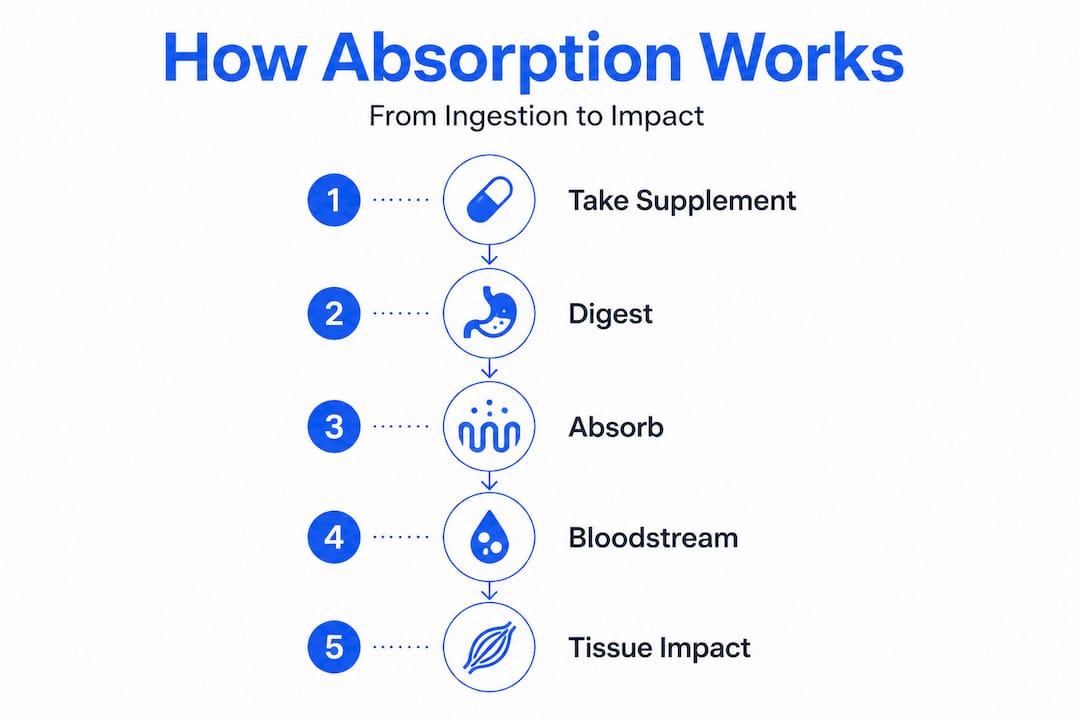
Bioavailability is the percentage of a nutrient or compound that actually enters your bloodstream and reaches active tissue after you consume it. It sounds simple, but it’s one of the most complex variables in supplement science.
Scientific methodologies for measuring bioavailability include balance studies, ileal digestibility assays, stable isotope tracing, and human pharmacokinetic trials. Each method captures a different slice of the absorption picture, and the gold standard remains the human trial with blood plasma sampling.
| Formulation type | Example | Bioavailability impact |
|---|---|---|
| Standard powder/capsule | Basic magnesium oxide | Low (around 4%) |
| Chelated mineral | Magnesium glycinate | High (up to 80%) |
| Liposomal | Liposomal vitamin C | Very high, bypasses gut degradation |
| Glycoside-rich extract | WS-35 ashwagandha | 118 to 267x better AUC than crude extracts |
| Food matrix bound | Whole food collagen peptides | Enhanced by co-factors naturally present |
That ashwagandha data is striking. WS-35 extract with high withanolide glycosides demonstrated 118 to 267 times better area under the curve (AUC) per gram compared to other ashwagandha preparations. AUC is the pharmacokinetic measure of total drug exposure over time, meaning more withanolides are actually available in your bloodstream for longer. That’s not a marginal difference. It’s the difference between a supplement that works and one that looks good on paper.
Factors affecting absorption beyond formulation include:
- Food matrix interactions: Fat-soluble vitamins (A, D, E, K) need dietary fat present to absorb properly
- Gut microbiome status: A compromised gut lining reduces passive diffusion of many compounds
- pH and gastric transit time: Some minerals compete for the same absorption pathways
- Co-factors: Vitamin D3 absorbs better alongside magnesium and K2 because these nutrients share enzymatic pathways
If you’re buying supplements without understanding how the formula was designed for absorption, you may be paying for benefits that never reach your tissues.
Evidence and limits: What clinical research actually shows
Not all supplements have an AREDS2 behind them. That landmark trial, funded by the National Institutes of Health, showed that a specific combination of lutein, zeaxanthin, and other antioxidants reduced AMD progression risk more effectively than the original formula. It’s one of the clearest examples of a supplement intervention producing measurable, clinically meaningful outcomes in a large randomized trial.
But AREDS2 is the exception, not the rule.
- Most supplements have never been studied in large, randomized, placebo-controlled human trials
- Many “science-backed” claims are supported only by in vitro (cell culture) or rodent studies
- Evidence for optimization in already-healthy individuals is particularly thin compared to correction of frank deficiencies
- Publication bias means positive results get published, while null results frequently don’t
This doesn’t mean supplements are useless. It means you need to apply appropriate skepticism proportional to the strength of the evidence behind specific products. Collagen peptides, for example, have solid human trial support for skin elasticity and joint comfort. Resveratrol, once heavily hyped, has struggled to replicate its cell-study results in human trials at practical doses.
Pro Tip: When evaluating a supplement, Google the ingredient name alongside “systematic review” or “meta-analysis.” These aggregate multiple studies and give a more reliable picture than any single trial.
What most supplement guides miss: Practical wisdom for discerning buyers
Here’s the honest reality most supplement content won’t tell you. The fact that a supplement is “natural” doesn’t mean it’s bioavailable, well-dosed, or tested in humans. The fact that it’s “ancient” doesn’t mean it’s safe at the concentrations found in modern capsules. And the fact that a label says “clinically studied” doesn’t mean the study was conducted in humans, powered appropriately, or independently replicated.
What experience and rigorous research actually suggest is that your supplement decisions should be built around three questions. First, has this specific formulation been tested in human pharmacokinetic studies? Second, is the manufacturing environment GMP-certified and independently verified? Third, is the dosing aligned with the amounts used in positive clinical trials, not just token amounts for label marketing?
We’ve seen too many products crowd their labels with 30 ingredients at doses too small to do anything measurable. A focused formula of clean, well-dosed compounds from reputable sources consistently outperforms a sprawling proprietary blend where no single ingredient reaches an effective threshold. Ancestral wisdom got the ingredients right. Modern science gets the formulation right. When both are applied together, with honesty and rigor, that’s when supplementation actually moves the needle.
Explore clean, science-backed supplements and skincare solutions
You now have the tools to evaluate any supplement with real discernment: check the formulation type, verify third-party testing, demand human trial evidence, and prioritize bioavailability over ingredient lists that look impressive but absorb poorly.

At Cohld, every product in our supplement collection is formulated with these exact principles. We source exclusively from GMP-compliant, U.S.-based facilities, using grass-fed and pasture-raised ingredients free from synthetic fillers and hormone disruptors. From collagen peptides to magnesium glycinate, the science behind each formula is built on bioavailability, not marketing copy. Explore our skin firming cream to see how the same standards apply to your skincare routine.
Frequently asked questions
How can I tell if a supplement is scientifically validated?
Look for supplements with published human trial results, standardized extracts, and third-party testing for purity and potency. Regulatory gaps mean “clinically studied” on a label is not sufficient on its own.
Why does bioavailability matter in supplements?
Bioavailability determines how efficiently your body absorbs and uses a supplement, directly impacting its effectiveness. Formulation choices like chelation, liposomal encapsulation, and glycoside enrichment can make the difference between a supplement that works and one that doesn’t.
Are all supplements regulated for safety in the U.S.?
Supplements are regulated post-market by the FDA under DSHEA, but most lack pre-market safety review. Choose brands with GMP certification and independent third-party testing as your baseline.
Do “science-backed” claims really guarantee supplement effectiveness?
“Science-backed” often refers to small studies with low certainty, so always verify whether human trials with appropriate sample sizes support the specific claims being made.
What supplement formulation increases absorption the most?
Glycoside-rich extracts, chelated minerals, and liposomal formulations consistently show the highest absorption rates. WS-35 ashwagandha extract demonstrated up to 267 times better bioavailability per gram compared to standard preparations, making formulation one of the most critical factors in supplement efficacy.